
The Anatomy of a Six-Figure Partnership: What Makes Partnerships Actually Work For Brands + Creators
The best partnerships have a little bit of chemistry.
Not the awkward, "we're both posting about the same product this week" kind. The real kind: the brand makes sense for the creator, the creator makes sense for the audience, and everyone involved can see why the relationship exists.
That's the difference between a campaign and a partnership.
And it's why some collaborations quietly generate enormous value while others—with bigger audiences, bigger budgets, and considerably more noise—disappear the moment the sponsored post does.
I've spent years on the brand side of this equation, managing hundreds of creator partnerships, seven-figure budgets, influencer programs, and affiliate channels. One thing I've learned is that the partnerships that perform best rarely come down to one brilliant tactic.
They have structure.
There's a clear objective. The right people are at the table. The audience connection makes sense. The economics work. Everyone knows what success looks like. And, ideally, the relationship has somewhere to go after the campaign ends.
In other words: good partnerships create momentum.
Here's what goes into building one.
The 9 Waves of a Powerful Partnership
A strong partnership typically has nine interconnected pieces:
Set the Current
Find Your People
Follow the Same Tide
Give Them a Reason to Dive In
Make the Exchange Worthwhile
Leave Room for the Magic
Build a Ripple Effect
Know What Made Waves
Keep the Current Going
The mistake is treating these as separate steps.
They're actually a system.
If the objective is wrong, partner selection suffers.
If the audience isn't aligned, content won't convert.
If compensation isn't structured properly, incentives become misaligned.
If you don't measure results, you don't know what to repeat.
And if you treat the entire thing as a one-time transaction, you may never discover what the partnership could have become.
Let's break it down.
01 — Set the Current
Start with the business objective.
Before you find the partner, define where you're trying to go.
Before a brand starts searching for creators—or a creator starts pitching brands—there needs to be a clear answer to:
What are we trying to accomplish?
This sounds obvious, but it's one of the most common places partnership strategy breaks down.
A brand might say:
"We want to work with influencers."
That's a tactic, not an objective.
The actual objective might be:
Generate $250,000 in incremental revenue
Increase awareness among a new audience
Drive bookings during a slow season
Generate high-quality UGC
Launch a new product
Acquire new customers
Increase affiliate revenue
Grow an email list
Build credibility within a specific community
Create an ongoing ambassador program
Each objective suggests a different partnership strategy.
A creator shouldn't approach every brand with the same pitch for the same reason.
If you're a creator, ask:
What business problem could my audience, expertise, content, or community help this brand solve?
If you're a brand, ask:
What do we actually need this partnership to accomplish?
Only then should you start looking for the right partner.
02 — Find Your People
Choose the right partner—not the biggest one.
The best partnership isn't necessarily the one with the largest following. It's the one with the right combination of audience, credibility, creativity, and potential.
This is where follower count gets dangerously seductive.
A creator with 500,000 followers isn't automatically more valuable than a creator with 25,000.
The better question is:
Who has the right combination of audience, influence, expertise, content, and commercial potential for this particular objective?
A creator evaluation might consider:
Audience — Do they reach the people we actually want?
Alignment — Do their values and interests fit the brand?
Trust — Does their audience believe their recommendations?
Content — Can they tell the story well?
Engagement — Does their audience meaningfully interact?
Conversion — Have they demonstrated the ability to drive action?
Professionalism — Are they reliable and easy to work with?
Creativity — Can they contribute ideas rather than simply execute briefs?
Longevity — Could this become a long-term relationship?
For creators, the same evaluation works in reverse.
Don't just ask: "Will this brand pay me?"
Ask: "Is this a brand I want my audience associating me with?"
That's an important distinction.
Your reputation is part of your business.
And creators increasingly value product quality, audience relevance, and brand reputation alongside financial upside when evaluating affiliate and brand opportunities.
03 — Follow the Same Tide
Look for genuine audience and values alignment.
The partnership should make sense to the people watching it.
A partnership works when there is a believable connection between:
brand x creator x audience
If any one of those three feels disconnected, the partnership becomes harder to sell.
Imagine a sustainable travel brand partnering with a creator whose audience is primarily interested in luxury shopping.
The creator might have enormous reach.
But the brand may be better served by someone with a smaller audience that is deeply interested in sustainable travel.
This is why we like to think about audience overlap rather than audience size.
Ask:
Who is this audience?
What do they care about?
What problems do they have?
What products do they already buy?
What recommendations do they trust?
Does this partnership make sense within the creator's existing content?
The strongest partnership should feel almost obvious to the audience.
Not: "Why are they promoting this?"
But: "Of course they love this."
That's the difference between an advertisement and an endorsement.
04 — Give Them a Reason to Dive In
Create an offer people actually want.
A discount is an offer. It's not necessarily a compelling reason to act.
A partnership needs a reason for the audience to act.
"Use my code for 10% off" can work.
But it isn't necessarily a strategy.
A compelling offer might be:
An exclusive discount
Early access
A creator-specific bundle
A limited-edition product
A unique experience
A bonus product
Free shipping
A special event
A membership incentive
A charitable component
A limited-time promotion
The offer should answer:
Why should someone do something now?
And it should make sense for the creator's audience.
A luxury travel creator might have more success offering an exclusive itinerary or experience than simply offering 10% off.
A fitness creator might create a class bundle.
A food creator might develop a recipe collection around the product.
A nonprofit creator partnership might focus on participation rather than purchase.
The best offers extend the story.
05 — Make the Exchange Worthwhile
Build compensation around value.
Money matters. So do commissions, usage, exclusivity, creative work, distribution, and long-term opportunity.
Compensation is one of the most misunderstood parts of creator partnerships. There isn't one universally "correct" rate.
A creator's value can come from:
Audience
Content creation
Expertise
Production quality
Distribution
Conversion
Usage rights
Exclusivity
Licensing
Affiliate revenue
Long-term relationship value
For example, a creator might receive one or more of the following:
flat fee • affiliate commission • performance bonus • usage fee • long-term retainer
The compensation structure can inform content performance, and sometimes including affiliate commission and/or performance bonuses to the payout, for example, can be more effective and efficient than simply paying a large upfront fee. It can also align incentives.
The creator has guaranteed compensation for their work while having additional upside if the partnership performs.
For brands, the goal isn't:
"How little can we pay?"
It's: "What compensation structure creates the right incentives for both sides?"
For creators, it's: "Am I being compensated for the full value I'm providing—not just the number of followers I have?"
06 — Leave Room for the Magic
Give creators room to create.
The brand knows the product. The creator knows their audience. The best work happens when neither side tries to do the other's job.
The best creator partnerships don't force creators to become brand spokespeople. They give creators enough context and direction to tell a compelling story in their own voice.
That requires a balance between brand needs and creator expertise.
Brand needs:
Key messaging
Required disclosures
Product information
Claims
Brand safety
Deliverables
Deadlines
Creator expertise:
Voice
Storytelling
Format
Audience trust
Creative concept
Personal experience
The brand knows the product. The creator knows the audience. The partnership works when both sides respect that expertise.
In fact, creators surveyed in CreatorIQ's 2025–26 research cited better communication, more creative input, and longer-term collaboration among the key factors that would make brand partnerships more successful.
So a good brief shouldn't tell a creator exactly what to say.
It should tell them what needs to be accomplished and give them room and creativity to figure out how to say it.
07 — Build a Ripple Effect
Think beyond the sponsored post.
Affiliate revenue, UGC, paid amplification, referrals, and repeat campaigns can turn one collaboration into a much bigger growth engine.
Here's where influencer marketing and affiliate marketing become particularly interesting together.
A traditional creator campaign might look like:
Brand pays creator → creator publishes content → campaign ends.
A partnership can become:
Brand pays creator → creator creates content → audience engages → creator drives sales → creator earns commission → brand tracks performance → both sides optimize → relationship continues.
That's a fundamentally different model. Affiliate doesn't have to replace flat-fee compensation. It can complement it.
For example:
$3,000 campaign fee + 10% affiliate commission + $1,000 performance bonus at $10,000 in attributed sales
Now both sides have a reason to care about the outcome. And creators get another opportunity to build recurring revenue rather than relying entirely on one-time sponsorships.
For brands, affiliate links, promo codes, and other performance mechanisms can help connect creator activity to actual business outcomes—especially as creator marketing budgets increasingly demand clearer ROI.
08 — Know What Made Waves
Measure what actually matters.
Reach is nice. Revenue, bookings, leads, new customers, and meaningful audience action are nicer.
One of the worst partnership mistakes is deciding what success means after the campaign ends.
Before launch, define:
Primary KPI — The one metric that matters most for this specific campaign.
Revenue
Bookings
New customers
Affiliate sales
Leads
Donations
Secondary KPIs — Supporting metrics that help complete the ROI story.
Reach
Engagement
Website traffic
Email signups
Content saves
Video views
UGC generated
Brand metrics — More longtail results that are harder to quantify directly following the campaign going live.
Brand awareness
Search lift
Sentiment
Audience growth
Share of voice
Don’t forget to establish your tracking infrastructure beforehand:
Vanity links
UTMs
Promo codes
Affiliate tracking
Landing pages
CRM attribution
Platform analytics
This is particularly important when you're investing significant dollars. You shouldn't have to guess whether a partnership worked.
As a brand, these KPIs and tracking systems should be communicated not only to the internal teams, but also to the creators. As a creator, if clear KPIs aren’t shared during briefing and contracting ahead of the campaign, ask the team “How are you measuring success for this campaign?” This creates a clear expectations and a shared goal.
09 — Keep the Current Going
Build the relationship, not just the campaign.
The most valuable partnership may be the one that happens after the first one.
This might be the most important piece of the entire framework. A great partnership shouldn't end when the final Reel goes live.
The best partnerships create a feedback loop:
Campaign → Results → Learning → Optimization → Next opportunity
Maybe the creator becomes an affiliate.
Maybe the brand increases the budget.
Maybe they develop a year-long ambassador relationship.
Maybe the creator helps develop a product.
Maybe they collaborate on an event.
Maybe the creator becomes part of the brand's ongoing community.
The possibilities expand when both sides stop asking: "What are we getting from this campaign?"
and start asking: "What could we build together?"
There is growing evidence and industry discussion around this shift toward longer-term creator relationships rather than one-off campaigns. Current creator-marketing research also points to creators wanting better communication, greater creative input, fair compensation, and ongoing collaboration.
And this is where partnerships start to compound.
So What Actually Makes a Partnership "Six-Figure"?
It's rarely one thing. It's the combination of strategic channels working together seamlessly.
Imagine a hypothetical creator partnership:
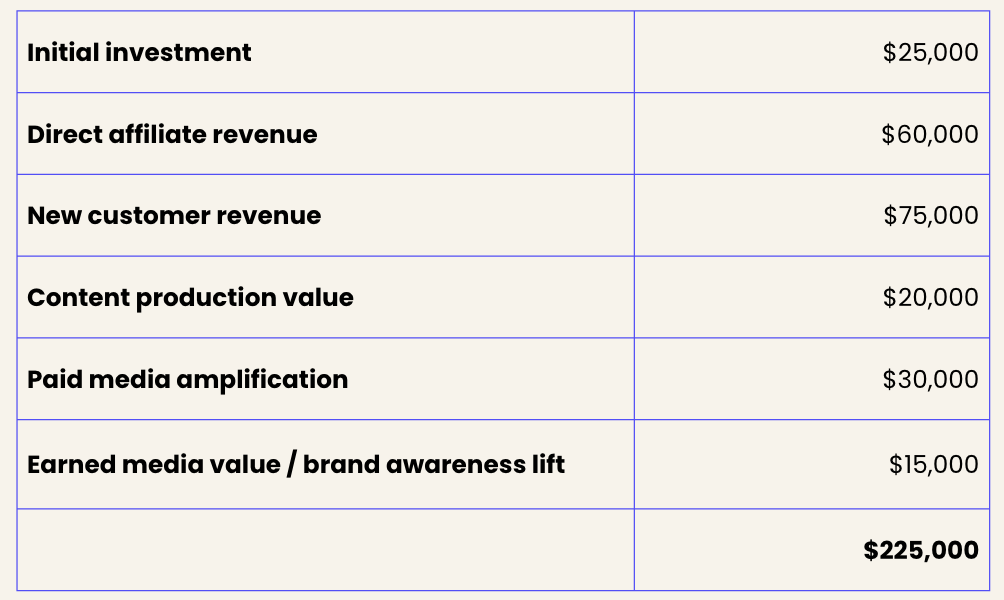
That's potentially a $200,000+ value ecosystem built around a $25,000 initial investment. But more importantly, imagine that the partnership continues. The creator becomes an ambassador. Affiliate revenue compounds. The brand gets more efficient content. The audience becomes familiar with the product. The creator's recommendation becomes more credible because it isn't a one-time promotion.
The Faire Onda Partnership Test
Before launching any creator, affiliate, or brand partnership, ask these five questions:
01 — Is there genuine alignment? Would this partnership make sense even if there were no money involved?
02 — Is there mutual value? Can both sides clearly articulate what they're getting?
03 — Is the audience connection believable? Would the audience naturally expect this partnership?
04 — Can we measure what matters? Do we know what success looks like before we start?
05 — Is there somewhere to go next? If this works, could the relationship become more valuable over time?
If you can't answer those questions positively, the partnership probably isn't ready to launch.
Don't Just Run a Campaign. Make a Ripple.
The most interesting thing about partnerships isn't the post. It's what happens because of the post.
New customers finds the brand.
Creators discover new revenue streams.
The audience finds something genuinely useful.
A one-time collaboration becomes an ongoing relationship.
Small ideas become much bigger ones.
That's the ripple.
And that's what makes a partnership worth building.
At Faire Onda, we believe growth doesn't have to come at the expense of relationships, creativity, or purpose. The best partnerships create value in more than one direction—and when they do, everyone has a reason to keep the current going.
Want to build your next partnership strategically?
Download the free Faire Onda Partnership Planning Worksheet.
In 20–30 minutes, you'll define your campaign objective, evaluate potential partners, map your budget and timeline, and establish the metrics you'll use to measure success—before you send the first pitch or partnership email.
A strategic workbook for building better brand + creator partnerships.
Before you send the pitch, build the plan. The Partnership Planning Worksheet helps brands and creators define their goals, evaluate alignment, map the investment, plan the partnership, and decide what success actually looks like—before anyone hits send.